

If you’ve shopped for a soundbar, TV, or pair of headphones lately, you’ve probably seen the term Dolby Atmos. But what is Dolby Atmos, exactly—and why does it matter for your next movie night or gaming session? In short, it’s an audio technology that places sounds in three-dimensional space, so audio doesn’t just come from around you; it comes from above and moves with incredible precision.
In this guide, we’ll explain how Dolby Atmos works, what gear you need to experience it, and practical steps to set it up at home. By the end, you’ll know whether it’s worth upgrading—and how to get the most immersive sound from your existing setup.
Introduction
If you have shopped for a soundbar, a TV, a smartphone, or a movie ticket in the past few years, you have almost certainly seen the words “Dolby Atmos” attached to it. The label shows up everywhere, but the technology behind it is rarely explained in plain language. This article explores What Is Dolby Atmos and How Does It Create Immersive Sound with clear, practical guidance, so you can decide whether it is worth your money and how to get the most from it. Understanding the fundamentals of What Is Dolby Atmos and How Does It Create Immersive Sound helps you make informed decisions, whether you are building a home theater, buying a laptop, or simply trying to understand why a movie sounded so compelling in the theater.
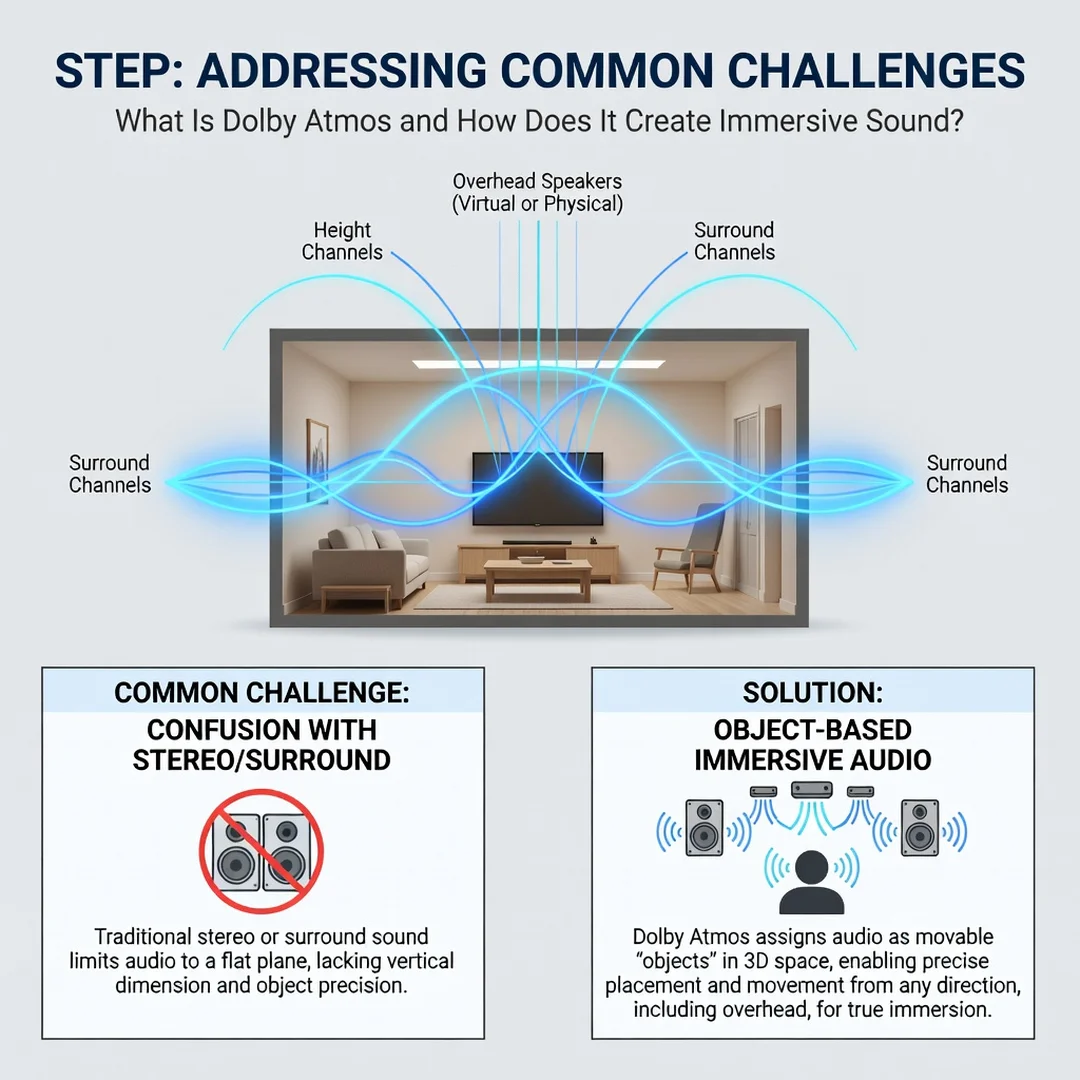
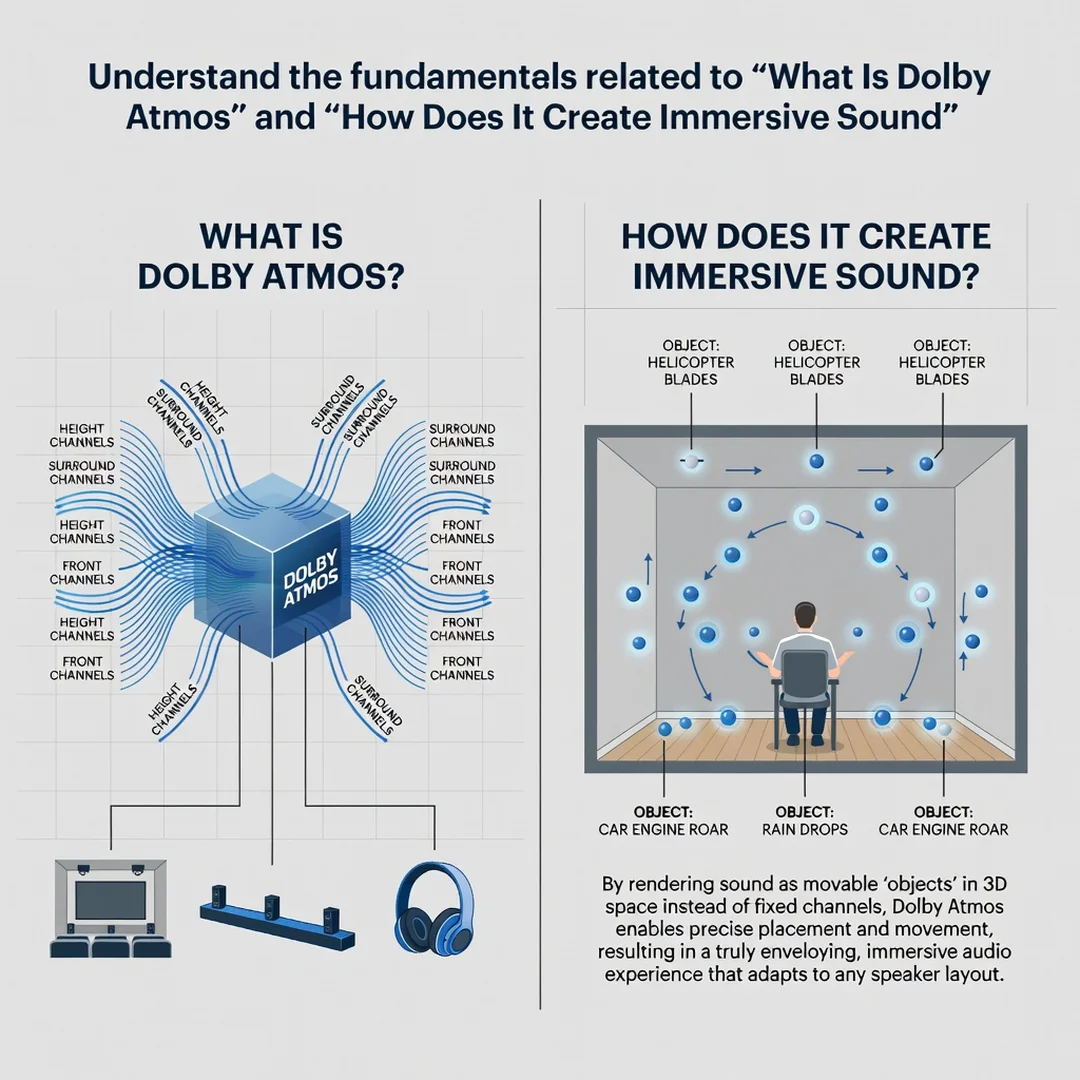
At its core, Dolby Atmos is an audio format that adds a sense of height and precise placement to sound. Instead of treating audio as a set of fixed channels, it treats each sound as an object that can be positioned anywhere in a three-dimensional space. That single idea is what makes rain seem to fall from above you, a helicopter seem to circle overhead, or a whispered conversation seem to come from directly behind your seat.
Key Concepts
To understand Atmos, it helps to first understand what came before it. Traditional surround sound formats, such as 5.1 and 7.1, are channel-based. The numbers refer to speakers placed around a room at a single ear-level plane: five or seven speakers around you, plus a subwoofer for low frequencies. The audio engineer decides which sound goes to which speaker, and the system plays it back that way. It works well, but it is fundamentally flat. There is no true “above.”
Dolby Atmos changes the model in three important ways.
- Audio objects: Instead of assigning a sound to a specific speaker, Atmos describes each sound as an independent object with a position in 3D space. A bird call can be an object placed at a specific coordinate above and to your left.
- Metadata and rendering: The Atmos mix includes instructions about where each object should be and how it should move. Your playback device, whether a soundbar, an AV receiver, or a pair of headphones, reads that metadata and renders the sound using whatever speakers you actually have.
- Height channels: Atmos supports speakers positioned above the listener, either mounted in or on the ceiling or, more commonly in homes, upward-firing speakers that bounce sound off the ceiling.
A related concept is the difference between a bed and objects. The “bed” is a traditional channel-based layer that carries ambient sound, music, and dialogue. Objects sit on top of that bed and can move freely. This hybrid approach means Atmos is backward compatible: a standard 5.1 system can still play an Atmos track, just without the height and precision benefits.
Finally, there is the question of delivery. Atmos can be embedded in streaming services, Blu-ray discs, game consoles, and even some broadcast content. The version you experience depends heavily on the source, the hardware, and the room.
Deep Dive
The magic of Atmos is not in any single speaker. It is in the renderer. When an Atmos signal reaches your device, the renderer knows two things: where each object should be, and what speakers are available. It then calculates how to distribute that object across the available speakers so the listener perceives it in the intended location. If you have a full 7.1.4 system with four ceiling speakers, the renderer can place objects very precisely. If you have a soundbar with two upward-firing drivers, it approximates the effect by bouncing sound off your ceiling.
This is why two Atmos systems can sound dramatically different. A high-end receiver with properly placed speakers will produce a far more convincing bubble of sound than a compact soundbar. That is not a flaw in Atmos; it is a reflection of physics. Sound placement depends on the room, the speaker positions, and the calibration.
How the height effect works
Human hearing is remarkably good at detecting elevation, partly because of the shape of our outer ears, which subtly filter high frequencies depending on whether a sound comes from above or below. Atmos exploits this by ensuring that height information reaches your ears with the right timing and frequency balance. Upward-firing speakers rely on ceiling reflections to simulate this, which is why ceiling height, ceiling material, and speaker angle matter so much.
Atmos for headphones
Dolby Atmos is not limited to speakers. Binaural rendering can simulate object placement over ordinary headphones using head-related transfer functions. The result is impressive but not identical to a full speaker system. Headphone Atmos is best for movies on a laptop or phone, and it can be surprisingly effective for games.
Content availability
Not everything labeled Atmos is created equal. Streaming services often use compressed versions with fewer objects and lower bitrates than Blu-ray. A disc-based Atmos track typically offers the most detail. Games can be excellent showcases because objects move dynamically with the player. Music in Atmos is growing but varies widely in quality.
Common misconceptions
- Atmos does not automatically mean better sound. A poor mix in Atmos is still a poor mix.
- More speakers do not guarantee a better experience. Placement and calibration matter more than raw count.
- Every Atmos label implies height. Some soundbars claim Atmos but rely entirely on virtualization, which can be subtle.
- You do not need a new receiver if yours already supports Atmos decoding. But you do need compatible speakers or a compatible soundbar.
Best Practices
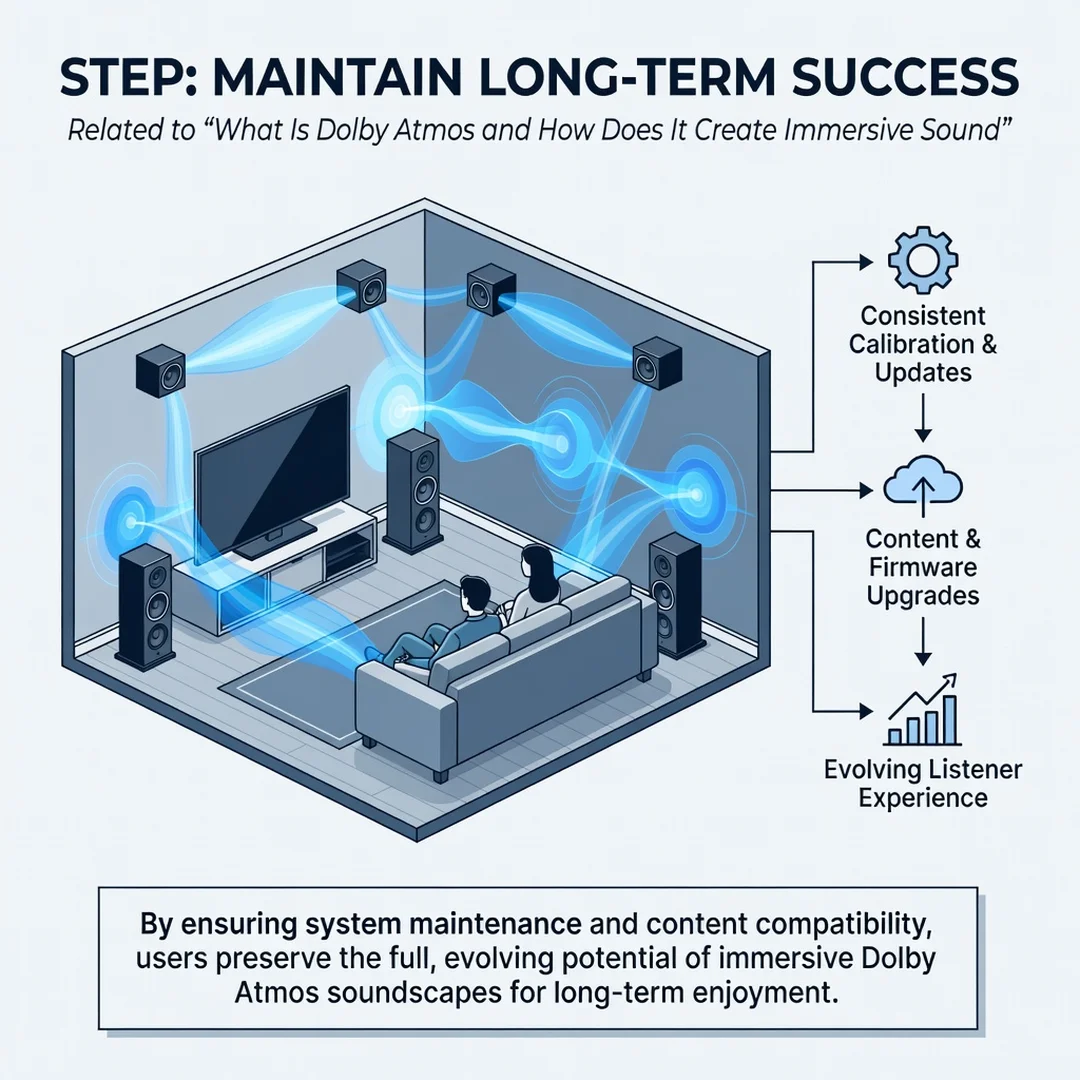
Getting the most from Dolby Atmos is less about buying the most expensive gear and more about matching the system to your room and your habits. Reliable information and consistent habits lead to better long-term outcomes, and that applies here as much as anywhere.
- Start with the room. A low, reflective ceiling helps upward-firing speakers. A very high or acoustically treated ceiling makes them less effective, and in-ceiling speakers become the better choice.
- Prioritize the center channel and subwoofer. Dialogue clarity and bass impact matter more to most viewers than height effects. A great 5.1.2 system beats a mediocre 7.1.4 system.
- Calibrate. Use the automatic room correction in your receiver or soundbar, then verify with a test tone. Small adjustments to speaker distance and level make a large difference.
- Match the source. Play Atmos content from a service or disc that actually delivers it. Check your streaming plan, your HDMI cables, and your audio output settings.
- Do not chase object counts. Marketing often cites the number of objects, but perceptually, placement and mixing skill matter more.
- Consider your seating. The sweet spot for Atmos is usually one or two rows. If your room has many seats, accept that the effect will be strongest in the center.
Step-by-Step Guide
The following steps apply whether you are setting up a new system or improving an existing one.
Step 1: Understand the fundamentals
Before buying anything, learn the difference between channel-based surround and object-based audio. Know what a bed is, what an object is, and why height channels matter. Understand that Atmos is a format, not a speaker. This knowledge prevents you from overspending on features you will not use and helps you ask better questions when comparing products.
Step 2: Assess your starting point
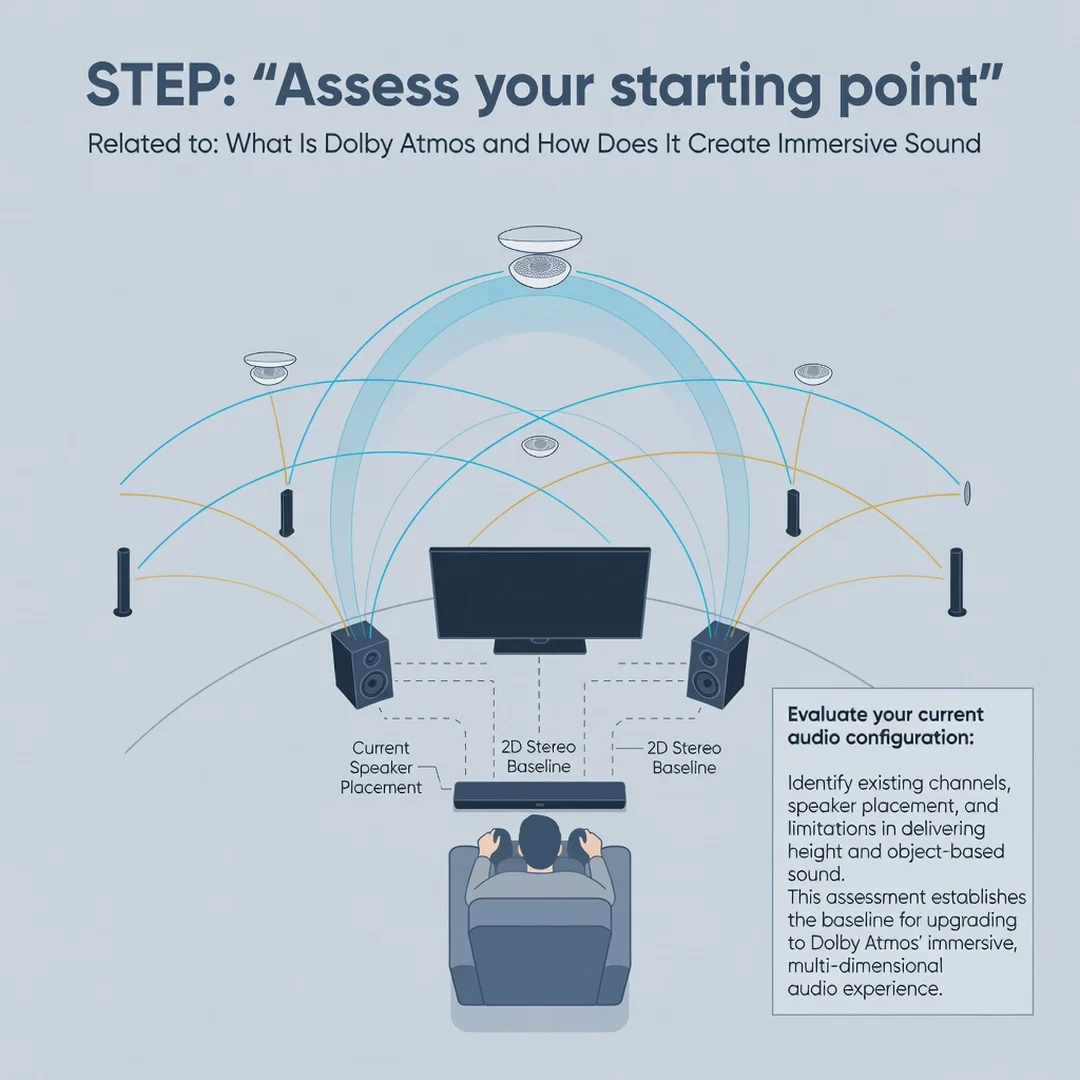
Take stock of what you already own. Does your TV or receiver support Atmos decoding? Do you have an HDMI eARC connection? What speakers do you have, and where are they placed? Measure your room and note the ceiling height and material. If you are using a soundbar, check whether it has dedicated upward-firing drivers or relies on virtual processing. Write down your current setup; it is the baseline for every decision that follows.
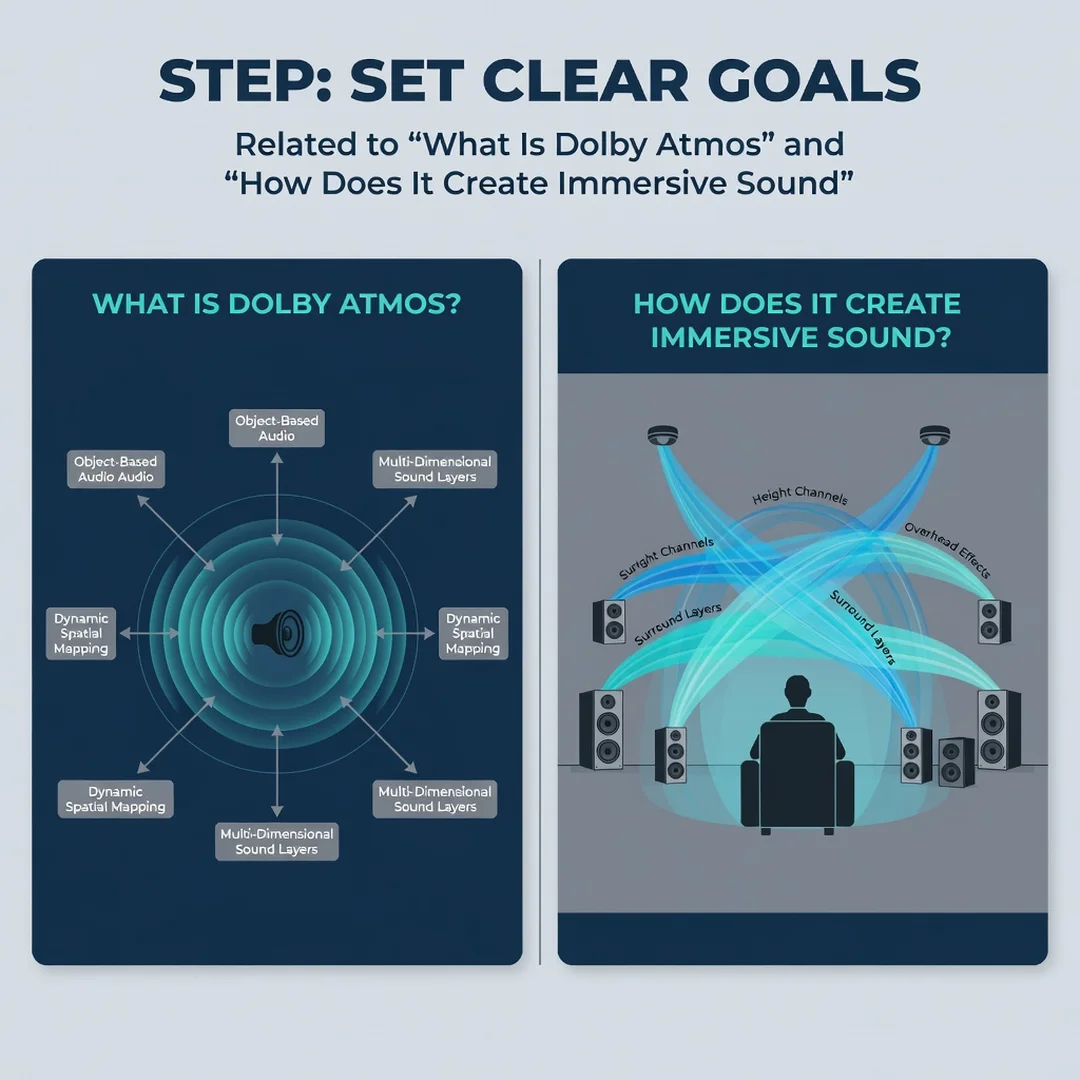
Step 3: Set clear goals
Decide what you actually want. Is your priority movie night with a dramatic overhead effect? Clear dialogue for a family room? Gaming with precise positional audio? Music? Each goal points to a different configuration. A budget soundbar with virtual Atmos may satisfy a casual viewer, while a dedicated home theater demands in-ceiling speakers and a capable receiver. Setting goals keeps your budget focused and your expectations realistic.
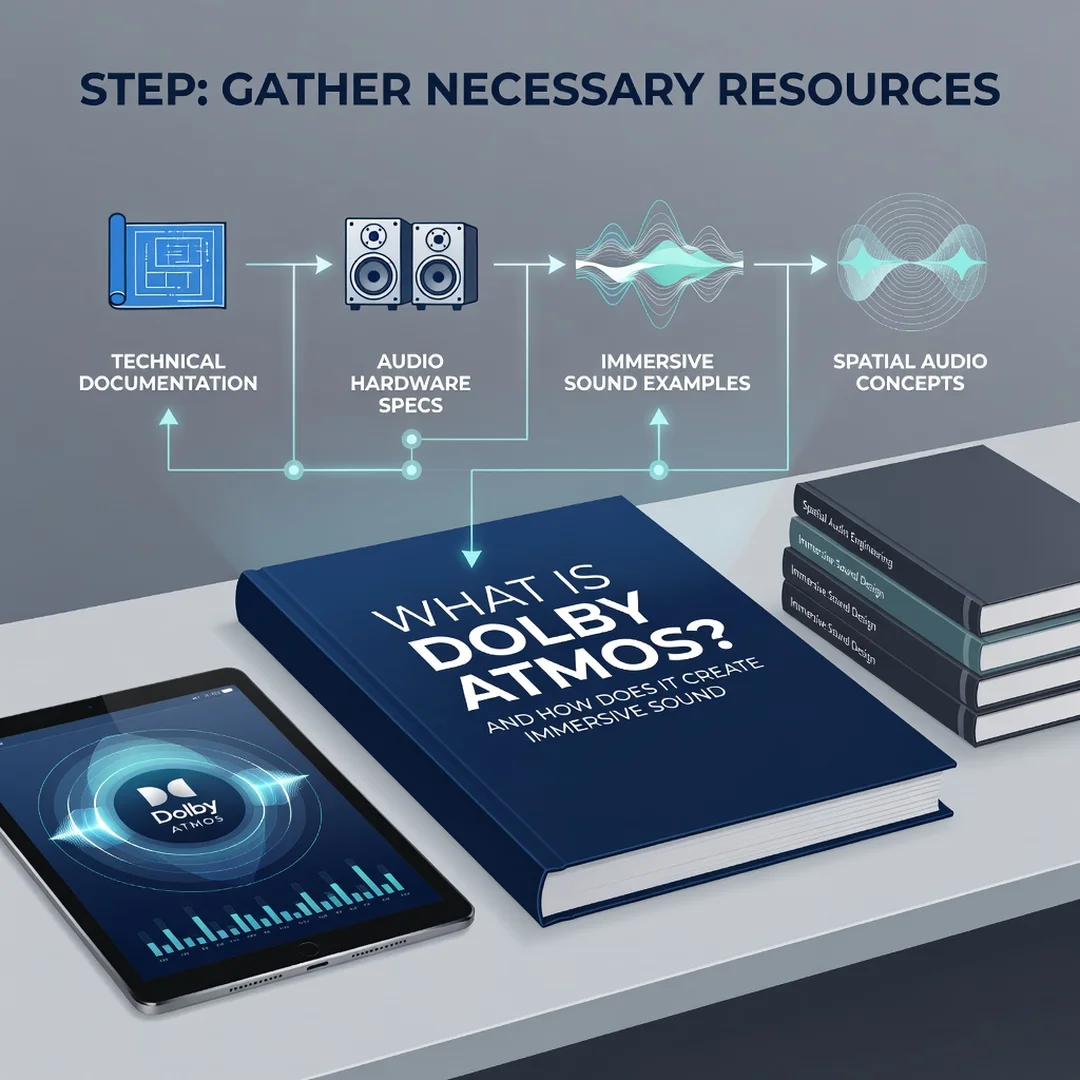
Step 4: Gather necessary resources
Collect the hardware and content you need. That may include an Atmos-capable receiver or soundbar, upward-firing or in-ceiling speakers, a subwoofer, appropriate HDMI cables, and a calibration microphone if your receiver includes one. On the content side, identify streaming services, discs, or games that offer genuine Atmos tracks. Check that your playback chain, from source to display to speakers, supports the format end to end.
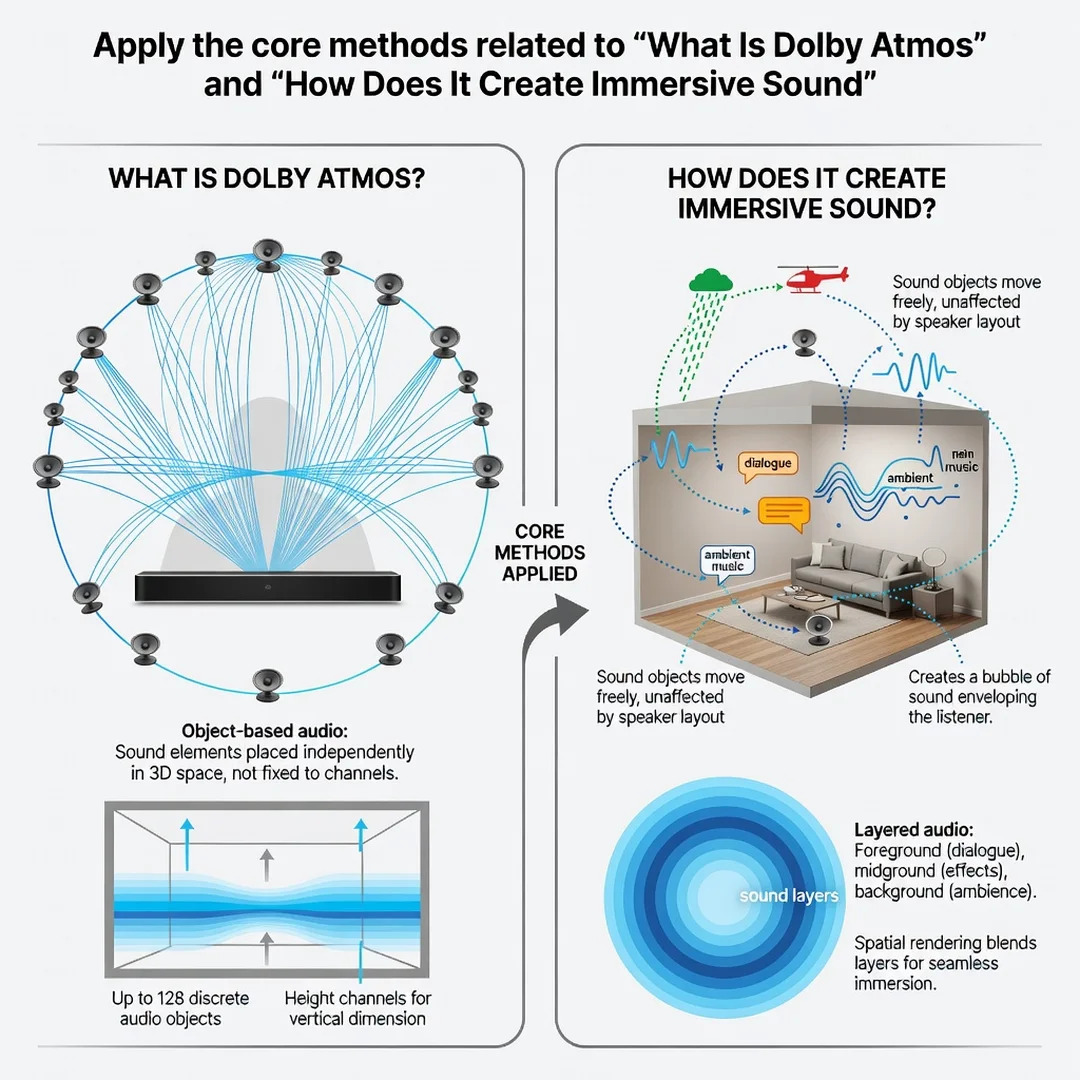
Step 5: Apply the core methods
Install and configure the system. Place speakers according to Dolby’s guidelines, with height speakers either overhead or angled toward the ceiling. Run automatic calibration, then fine-tune distances, levels, and crossover settings. Test with a variety of content: a dialogue-heavy scene, an action sequence, and a music track. Pay attention to whether height effects feel natural rather than forced. Adjust speaker angles in small increments and re-test.
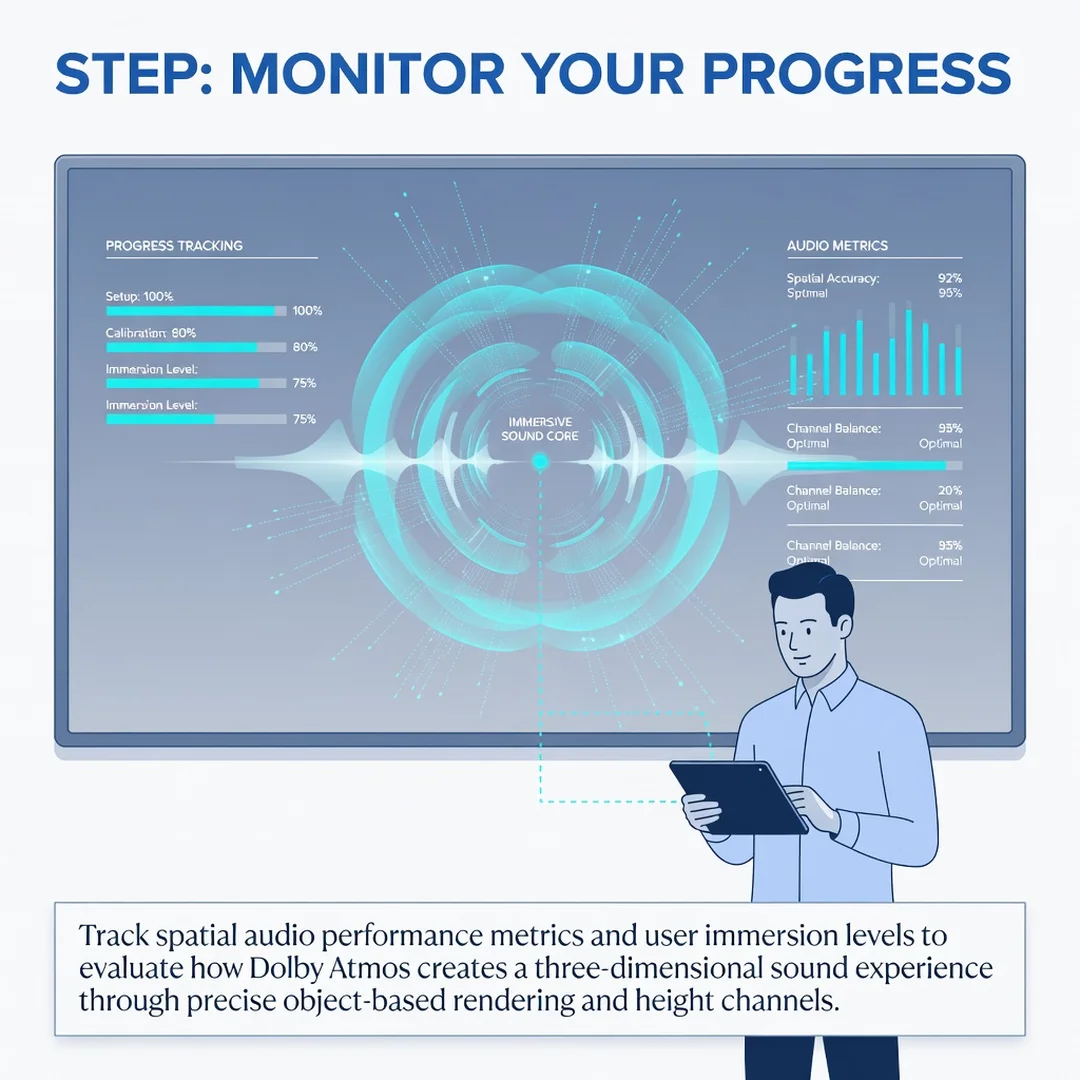
Step 6: Monitor your progress
After setup, live with the system for a week. Note which scenes impress you and which feel flat. Revisit calibration if dialogue is unclear or overhead effects seem weak. As you add content or upgrade a component, re-check your settings. Consistent habits, such as verifying the audio format on your receiver’s display before a movie, ensure you are actually getting Atmos and not a downmixed signal.
FAQ
What should I know about What Is Dolby Atmos and How Does It Create Immersive Sound?
The most important thing to know is that Atmos is object-based rather than channel-based. It places sounds in three-dimensional space using metadata, and your playback device renders those sounds based on the speakers you have. That means your experience depends on your hardware, your room, and the quality of the source. A true Atmos setup includes height channels or upward-firing speakers, and a.
You now have a solid foundation for What Is Dolby Atmos and How Does It Create Immersive Sound. Apply the best practices above and revisit this guide as your needs evolve.